Sunday, November 05, 2006
Saturday, November 04, 2006
 Vatican II's emphasis on the importance of the Liturgy of the Word:
Sacred scripture is of the greatest importance in the celebration of the liturgy. For it is from scripture that lessons are read and explained in the homily, and psalms are sung; the prayers, collects, and liturgical songs are scriptural in their inspiration and their force, and it is from the scriptures that actions and signs derive their meaning. Thus to achieve the restoration, progress, and adaptation of the sacred liturgy, it is essential to promote that warm and living love for scripture to which the venerable tradition of both eastern and western rites gives testimony.
"Of the greatest importance" is an important phrase of which to be mindful. It underscores the council's intent to enrich the development and celebration of liturgy, and I stress, not to create or recreate an inherent hierarchy of Christ's presences. It would be inappropriate and beyond the spirit of worship to emphasize one or some to the detriment of others. All encounters with Christ--sacrament, Word, gathered assembly, presiding minister, the poor, as well as symbols and images of devotion--all of them are significant. They are not in competition.
Vatican II's emphasis on the importance of the Liturgy of the Word:
Sacred scripture is of the greatest importance in the celebration of the liturgy. For it is from scripture that lessons are read and explained in the homily, and psalms are sung; the prayers, collects, and liturgical songs are scriptural in their inspiration and their force, and it is from the scriptures that actions and signs derive their meaning. Thus to achieve the restoration, progress, and adaptation of the sacred liturgy, it is essential to promote that warm and living love for scripture to which the venerable tradition of both eastern and western rites gives testimony.
"Of the greatest importance" is an important phrase of which to be mindful. It underscores the council's intent to enrich the development and celebration of liturgy, and I stress, not to create or recreate an inherent hierarchy of Christ's presences. It would be inappropriate and beyond the spirit of worship to emphasize one or some to the detriment of others. All encounters with Christ--sacrament, Word, gathered assembly, presiding minister, the poor, as well as symbols and images of devotion--all of them are significant. They are not in competition.
Friday, November 03, 2006
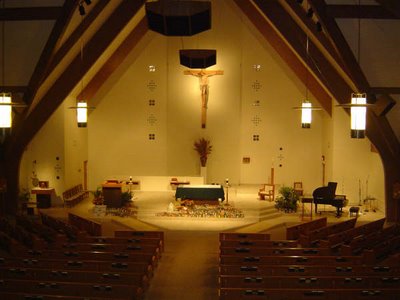
 And the interior from the choir loft. The clutter in front of the altar is from last week's diocesan jubilee event at a school Mass: 50 cans of food from every classroom on the 50th day of school in the 50th year of the merged dioceses.
Here's an interior looking toward the south window. You can see our patron in the right third of the window. A little tougher to make out is the carpenter Joseph with young Jesus in the upper portion. Sacraments are portrayed in the bottom section.
 This image shows a bit of the northern Mary window. My favorite quiz is to ask a child (or adult) to discern as many of the mysteries of the rosary as she or he can. You might not be able to, but this gives you an idea of where I am on weekends.
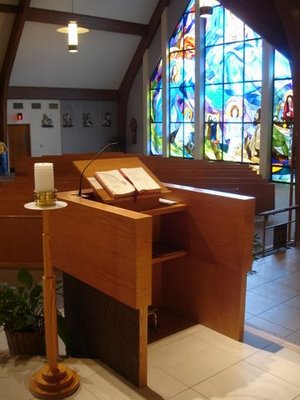
It's a nice church. Better than it was when it was built. It has its little problems. And a few big ones. But I've grown very accustomed to the building and the people who come to worship in it.
 I have the software downloaded and the new Catholic Sensibility site up, but I can't figure out how to make WordPress do what I want it to do. Ack. Maybe another day. Blogger seems to be regurgitating all the pretty pictures I posted this morning, so the Big Switch will likely be put off till after next Monday's neighborhood leaf collection. And I still have to confer with my collaborator Neil to get his input. After that, it will be sorting and sifting through over 2,000 posts to categorize and make my Vatican II series easily accessible for theology geeks.
Meanwhile, I've upgraded the links on the left to include Kathy and Gavin, two fine people with blogs worth visiting and visiting often. And a few Mars sites under Cassini.
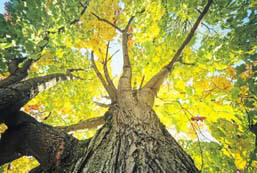
And in other neighborhood news, somebody should inform my two oak trees that it's okay to drop their leaves now. They're a nice mellow yellow-brown. Not as spectacular as maples, but not trunk-ugly either. My driveway is full of ground acorns. If the leaves would follow, my neighborhood association would appreciate it.
Last two winters, the dang trees kept many of their leaves till spring. Talk about herneneutic of obstruction.
I have the software downloaded and the new Catholic Sensibility site up, but I can't figure out how to make WordPress do what I want it to do. Ack. Maybe another day. Blogger seems to be regurgitating all the pretty pictures I posted this morning, so the Big Switch will likely be put off till after next Monday's neighborhood leaf collection. And I still have to confer with my collaborator Neil to get his input. After that, it will be sorting and sifting through over 2,000 posts to categorize and make my Vatican II series easily accessible for theology geeks.
Meanwhile, I've upgraded the links on the left to include Kathy and Gavin, two fine people with blogs worth visiting and visiting often. And a few Mars sites under Cassini.
And in other neighborhood news, somebody should inform my two oak trees that it's okay to drop their leaves now. They're a nice mellow yellow-brown. Not as spectacular as maples, but not trunk-ugly either. My driveway is full of ground acorns. If the leaves would follow, my neighborhood association would appreciate it.
Last two winters, the dang trees kept many of their leaves till spring. Talk about herneneutic of obstruction.Where ever you find this kind of nonsense - and it is nonsense - you'll find a disdain for the "hierarchical" church, tradition, and rules. Chances are very good that you'll find a lot of talk simply about "Gospel values" and maybe, as they attempt to justify their liturgical stylings, a vague appeal to Early Christianity. You know, when it was all just a supper n' stuff.I can tell you that this Costume Mass would fly with no liturgist colleague I know. In fact, it's more likely to be retold over a beer or in a convention hall with a lot of snickers--not unlike St Blog's commentariat, to be honest. It's far more likely this event was dreamed up by someone steeped in the pseudo-liturgical catechesis front. That said, traditionalists don't always give hierarchy, tradition, and rules a free pass either.
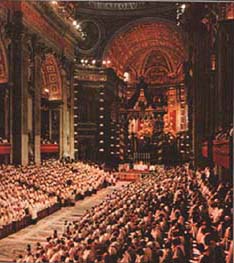 More on general norms to be used in liturgical reform
That sound tradition may be retained, and yet the way remain open to legitimate progress careful investigation is always to be made into each part of the liturgy which is to be revised. This investigation should be theological, historical, and pastoral.
Hindsight might tell us that liturgical investigation was somewhat rushed after the council. Others would argue this liturgical examination was going on for decades prior to Vatican II.
Also the general laws governing the structure and meaning of the liturgy must be studied in conjunction with the experience derived from recent liturgical reforms and from the indults conceded to various places. Finally, there must be no innovations unless the good of the Church genuinely and certainly requires them; and care must be taken that any new forms adopted should in some way grow organically from forms already existing.
Sacrosanctum Concilium's sole reference to organic development of liturgical innovation. It references organic growth as a desirable ("should") but not an absolute ("must").

 Vatican II details "general norms" mentioned in the last section:
2. In virtue of power conceded by the law, the regulation of the liturgy within certain defined limits belongs also to various kinds of competent territorial bodies of bishops legitimately established.

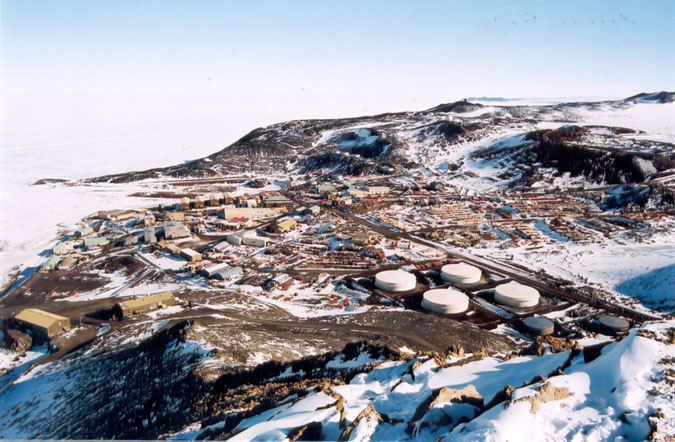 I've often wondered about ministry in Antarctica. Do the various bases have chaplains? How are they staffed? Who's responsible? Nancy Frazier O'Brien's CNS feature story profiles Father John Harrison of the New Zealand diocese of Dunedin, who recently flew to McMurdo Station for his fifth tour as chaplain. The outpost on Ross Island, seen here on the left, houses more than a thousand researchers and support staff each Antarctic summer from October to February.
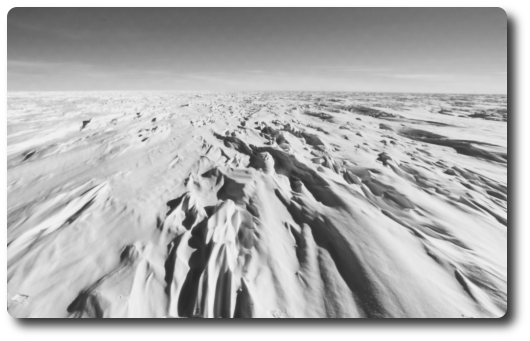 Father Harrison reflects:
"When you fly into the South Pole, you realize that nearly all you're looking at no human being has ever set foot on.It's a real reflective time, when you can't help but focus on God and creation."
Father Harrison reflects:
"When you fly into the South Pole, you realize that nearly all you're looking at no human being has ever set foot on.It's a real reflective time, when you can't help but focus on God and creation."
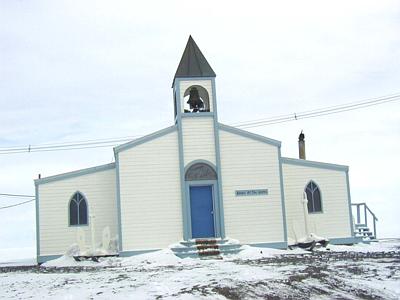
 The southernmost known church on the planet, the Chapel of the Snows, has an interesting history.
Here's a photo of the 1956 edition of the chapel. Military personnel setting up the American outpost for the International Geophysical Year had not included it in the original plans. Religious services were slated to be held in the mess hall.
Admiral George Dufek, in the Antarctic Journal, December 1978 recalls the tale of the labors of Navy chaplain John Condit and his volunteers:
The southernmost known church on the planet, the Chapel of the Snows, has an interesting history.
Here's a photo of the 1956 edition of the chapel. Military personnel setting up the American outpost for the International Geophysical Year had not included it in the original plans. Religious services were slated to be held in the mess hall.
Admiral George Dufek, in the Antarctic Journal, December 1978 recalls the tale of the labors of Navy chaplain John Condit and his volunteers:
"As the construction of the buildings at McMurdo progressed, a mysterious pile of lumber, planks, nails, Quonset hut sections, and assorted materials began to accumulate on a knoll overlooking the camp. Before the main camp was finished a tidy neat church with a steeple was to stand on a ridge overlooking the camp. Later it even had a bell, procured from a small gasoline tanker."A real bell: that's a plus. Fire claimed the building in 1978, and it was more than ten years before McMurdo folks had a new Chapel of the Snows, built on a knoll overlooking McMurdo Sound and the nearby mountains and glaciers.
 US Navy chaplains began serving Antarctic personnel in 1955. Today Catholic chaplaincy is coordinated by the Diocese of Christchurch, New Zealand. Catholic chaplains are assigned for about a month each during that October to February stretch. A small contingent of personnel remains to winter at McMurdo. These folks are served by lay ministers trained by the chaplains to lead celebrations of the Liturgy of the Word.
While Harrison is on duty, he will preside at daily Mass for a mostly American congregation. "They come here from a huge diversity of areas, from whole different cultural backgrounds and different styles of parishes," Harrison says. "But their unity comes in Christ." He also leads Bible studies and counsels people who sometimes struggle to live and work far from family and home in this remote place. Some people have begun a journey of initiation with Harrison and continue in RCIA once they return home.
US Navy chaplains began serving Antarctic personnel in 1955. Today Catholic chaplaincy is coordinated by the Diocese of Christchurch, New Zealand. Catholic chaplains are assigned for about a month each during that October to February stretch. A small contingent of personnel remains to winter at McMurdo. These folks are served by lay ministers trained by the chaplains to lead celebrations of the Liturgy of the Word.
While Harrison is on duty, he will preside at daily Mass for a mostly American congregation. "They come here from a huge diversity of areas, from whole different cultural backgrounds and different styles of parishes," Harrison says. "But their unity comes in Christ." He also leads Bible studies and counsels people who sometimes struggle to live and work far from family and home in this remote place. Some people have begun a journey of initiation with Harrison and continue in RCIA once they return home.
 Here's the chapel interior, if you're curious.
McMurdo chaplains each take a flight of 840 miles to the South Pole Station to check in on the much smaller base set up there.
Here's the chapel interior, if you're curious.
McMurdo chaplains each take a flight of 840 miles to the South Pole Station to check in on the much smaller base set up there.
 One historic artifact of interest is the Erebus Chalice, carried on the HMS Erebus' 1841 expedition to the continent. Each summer, it is returned to McMurdo for display, returning to spend New Zealand winters on display in the Christ Church Cathedral in Christchurch.
Did you notice that penguin in the stained glass at the top of the post?
One historic artifact of interest is the Erebus Chalice, carried on the HMS Erebus' 1841 expedition to the continent. Each summer, it is returned to McMurdo for display, returning to spend New Zealand winters on display in the Christ Church Cathedral in Christchurch.
Did you notice that penguin in the stained glass at the top of the post?“(W)e here gather around the table where we know the giving of peace is to be found and where food we serve here nourishes not only the body but our heart. We gather in knowing there is a Balm in Gilead that will, if we but accept it, heal the sin-sick soul. What a wonderful sight it is to see so many people of this parish and the archdiocese gather in harmony and peace to rejoice in our diversity, and to do so because Christ is one and He belongs equally to all of us.”Tom Nemchik, lay person:
"(The Mass) allows me to appreciate that we are one body in Christ. You can go to any Mass in any language and still be able to participate. It allows me to offer my Catholicism as a Slovak to others who might be interested.”Hmmm ... any language. Good thinking.
 A good amount of ring posts on this week's Cassini site, including this image showing those ghostly "spokes" aligned ad siderum.
Voyager 1 first spotted the spokes on its 1980 flyby of Saturn. Scientists were completely clueless, as the spokes appeared to violate the laws of physics. Today we suspect they are some interaction between Saturn's magnetic field and superfine particles in the rings. The particles are elevated above the plane of the rings and align with magnetic field lines created by the planet.
A good amount of ring posts on this week's Cassini site, including this image showing those ghostly "spokes" aligned ad siderum.
Voyager 1 first spotted the spokes on its 1980 flyby of Saturn. Scientists were completely clueless, as the spokes appeared to violate the laws of physics. Today we suspect they are some interaction between Saturn's magnetic field and superfine particles in the rings. The particles are elevated above the plane of the rings and align with magnetic field lines created by the planet.Thursday, November 02, 2006
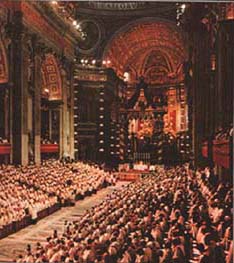 Now we get to some of the principles laid down for actual liturgical reform in this subsection of chapter 1, entitled, "The Reform of the Sacred Liturgy."
 In order that the Christian people may more certainly derive an abundance of graces from the sacred liturgy, holy
This is a clear start that tells us two important things. The council bishops wish that believers would derive more spiritual benefit from the liturgy. To achieve that goal, a "restoration" is deemed as necessary.
For the liturgy is made up of immutable elements divinely instituted, and of elements subject to change. These not only may but ought to be changed with the passage of time if they have suffered from the intrusion of anything out of harmony with the inner nature of the liturgy or have become unsuited to it.
For many, this is the tricky point. Many elements "subject to change" might well be the object of deep attachment, or even theological significance or truth, but do they belong in the Mass? This section also suggests that what may have been right or important once for the Christian believer, might come to no longer be so.
In this restoration, both texts and rites should be drawn up so that they express more clearly the holy things which they signify; the Christian people, so far as possible, should be enabled to understand them with ease and to take part in them fully, actively, and as befits a community.
So the community, their needs, and the goal of their participation is the measure of judgment for changeable items.
Wednesday, November 01, 2006
 Reading about the emerging media in Vatican II is always interesting. Here, the council bishops acknowledge television as a media force, but they acknowledge the bishop may not be the most competent to make judgments.
Transmissions of the sacred rites by radio and television shall be done with discretion and dignity, under the leadership and direction of a suitable person appointed for this office by the bishops. This is especially important when the service to be broadcast is the
Reading about the emerging media in Vatican II is always interesting. Here, the council bishops acknowledge television as a media force, but they acknowledge the bishop may not be the most competent to make judgments.
Transmissions of the sacred rites by radio and television shall be done with discretion and dignity, under the leadership and direction of a suitable person appointed for this office by the bishops. This is especially important when the service to be broadcast is the 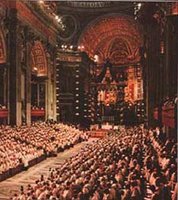 Tonight's post describes the role of the pastor, including yet another mention of active participation:
With zeal and patience, pastors of souls must promote the liturgical instruction of the faithful, and also their active participation in the liturgy both internally and externally, taking into account their age and condition, their way of life, and standard of religious culture. By so doing, pastors will be fulfilling one of the chief duties of a faithful dispenser of the mysteries of God; and in this matter they must lead their flock not only in word but also by example.
Leading by example. One of the highest compliments I've heard parishioners give about a priest is the prayerful way he prays the Mass. My current pastor is an absolute gem in that regard. He listens to the readings others are proclaiming. He sings. His clear focus during the Eucharistic Prayer is evident.
Anybody with outstanding examples of clerical example?
Tonight's post describes the role of the pastor, including yet another mention of active participation:
With zeal and patience, pastors of souls must promote the liturgical instruction of the faithful, and also their active participation in the liturgy both internally and externally, taking into account their age and condition, their way of life, and standard of religious culture. By so doing, pastors will be fulfilling one of the chief duties of a faithful dispenser of the mysteries of God; and in this matter they must lead their flock not only in word but also by example.
Leading by example. One of the highest compliments I've heard parishioners give about a priest is the prayerful way he prays the Mass. My current pastor is an absolute gem in that regard. He listens to the readings others are proclaiming. He sings. His clear focus during the Eucharistic Prayer is evident.
Anybody with outstanding examples of clerical example?All Saints’ Day is a good time to remember that while most saints led lives of quiet service, some led the life of the noisy prophet, speaking the truth to power — even when that power was within the church.Sisters with spines: what a thought! Maybe Mother Guerin will be a patron of sorts for VOTF.
 Read it, then discuss the two things priests are called to do.
Priests, both secular and religious, who are already working in the Lord's vineyard are to be helped by every suitable means to understand ever more fully what it is that they are doing when they perform sacred rites; they are to be aided to live the liturgical life and to share it with the faithful entrusted to their care.
Read it, then discuss the two things priests are called to do.
Priests, both secular and religious, who are already working in the Lord's vineyard are to be helped by every suitable means to understand ever more fully what it is that they are doing when they perform sacred rites; they are to be aided to live the liturgical life and to share it with the faithful entrusted to their care.
1. Deepening their understanding of what they do--that's a tall order. It implies that a substantial part of a diocese's or order's continuing education of its clergy should focus on liturgy.
2. That sharing of the liturgical life with the faithful includes Liturgy of the Hours, wouldn't you say?
Any priests out there with comments on how they are helped or hindered in following through on SC 18? Or lay people with bad or especially good examples of clergy they know?
Tuesday, October 31, 2006
 More on liturgical formation:
In seminaries and houses of religious, clerics shall be given a liturgical formation in their spiritual life. For this they will need proper direction, so that they may be able to understand the sacred rites and take part in them wholeheartedly; and they will also need personally to celebrate the sacred mysteries, as well as popular devotions which are imbued with the spirit of the liturgy. In addition they must learn how to observe the liturgical laws, so that life in seminaries and houses of religious may be thoroughly influenced by the spirit of the liturgy.
"Liturgical formation in their spiritual life." What exactly does that mean, would you say?
More on liturgical formation:
In seminaries and houses of religious, clerics shall be given a liturgical formation in their spiritual life. For this they will need proper direction, so that they may be able to understand the sacred rites and take part in them wholeheartedly; and they will also need personally to celebrate the sacred mysteries, as well as popular devotions which are imbued with the spirit of the liturgy. In addition they must learn how to observe the liturgical laws, so that life in seminaries and houses of religious may be thoroughly influenced by the spirit of the liturgy.
"Liturgical formation in their spiritual life." What exactly does that mean, would you say?
Monday, October 30, 2006
 After some heavy European history earlier this month, I had some fun this past weekend with Chris Roberson's Paragaea, reviewed here.
I was reading the history mainly to get a sense of the Church's role in the Great War. I learned that the French almost pitched away victory because of their cultural anti-Catholicism. I read of how military leaders were snail-slow to take advantage of the advances in military technology, and how they continued to throw soldiers into harm's way simply by conducting a 20th century war with their brains (if not butts) in the Napoleonic Era. It made me wonder about Iraq even more.
After some heavy European history earlier this month, I had some fun this past weekend with Chris Roberson's Paragaea, reviewed here.
I was reading the history mainly to get a sense of the Church's role in the Great War. I learned that the French almost pitched away victory because of their cultural anti-Catholicism. I read of how military leaders were snail-slow to take advantage of the advances in military technology, and how they continued to throw soldiers into harm's way simply by conducting a 20th century war with their brains (if not butts) in the Napoleonic Era. It made me wonder about Iraq even more.The hardcover hymnal, which is used daily in Christ the King Chapel, consists of a comprehensive selection of music styles including traditional hymnody and contemporary songs, as well as Gregorian chant and praise and worship songs.
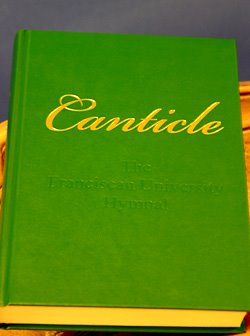 I looked at it for about five minutes today. Lots of praise and worship songs. Lots. Five Mass settings by Jim Cowan. Only two by Marty Haugen. Some plainsong, but probably more bits from GIA's contemporary psalms. A good quantity of hymns with "questionable" theology, as they say.
I'd be curious to know what my reform2 friends think of this. Or anybody else.
I looked at it for about five minutes today. Lots of praise and worship songs. Lots. Five Mass settings by Jim Cowan. Only two by Marty Haugen. Some plainsong, but probably more bits from GIA's contemporary psalms. A good quantity of hymns with "questionable" theology, as they say.
I'd be curious to know what my reform2 friends think of this. Or anybody else. What do you think, liebchens? Good idea? Necessary idea? Pastoral disaster? I'll weigh in tomorrow with my opinion.
 Here's the latest full color image from Saturn, looking down on the dark side of the rings. The bright sliver on the lower left is the crescent of the day side of the planet.
Looks like Blogger has its act together today. Let's see if I can replicate some of last Friday's lost post on moons. Blogosphere, meet Janus:
Here's the latest full color image from Saturn, looking down on the dark side of the rings. The bright sliver on the lower left is the crescent of the day side of the planet.
Looks like Blogger has its act together today. Let's see if I can replicate some of last Friday's lost post on moons. Blogosphere, meet Janus:
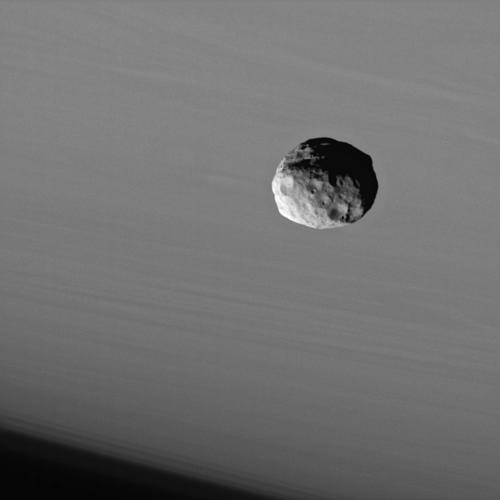 Janus is one of Saturn's relatively small shepherd moons. Janus is 113 miles across--about the size and shape of Connecticut and Rhode Island put together. Old tiney space artists (as well as George Lucas) assumed that these small moons would be craggy, rocky bits. Yet the truth is not so. Check out this gallery of solar system moons ...
 First Telesto:
 And Mars' moon Phobos:
These babies have craters, yes, but their contours are surprisingly rounded compared to what we thought we'd find in space. It turns out that we have erosion in space: radiation from the sun, solar wind particles, and the like. There's also a presumption that there are fine grains of dust covering these small bodies. Dust made of ice, as in the case at Saturn. Dust made of teeny particles of stone, as in the case at Phobos and our own moon.
Static electricity is also a space event. Scientists are a bit worried about the possible effects of electric charge when astronauts go exploring. Will computers freak out? I blogged on this a few months ago, but all this dust in space is potentially hazardous to space travellers if it gets in their machinery, or especially, their lungs, where it can asphyxiate in minutes if it gets dragged back into the crew compartment.
Anyway, that's decades in the future. For now, enjoy the pretty pictures.
And Mars' moon Phobos:
These babies have craters, yes, but their contours are surprisingly rounded compared to what we thought we'd find in space. It turns out that we have erosion in space: radiation from the sun, solar wind particles, and the like. There's also a presumption that there are fine grains of dust covering these small bodies. Dust made of ice, as in the case at Saturn. Dust made of teeny particles of stone, as in the case at Phobos and our own moon.
Static electricity is also a space event. Scientists are a bit worried about the possible effects of electric charge when astronauts go exploring. Will computers freak out? I blogged on this a few months ago, but all this dust in space is potentially hazardous to space travellers if it gets in their machinery, or especially, their lungs, where it can asphyxiate in minutes if it gets dragged back into the crew compartment.
Anyway, that's decades in the future. For now, enjoy the pretty pictures. More on the study of liturgy:
The study of sacred liturgy is to be ranked among the compulsory and major courses in seminaries and religions houses of studies; in theological faculties it is to rank among the principal courses. It is to be taught under its theological, historical, spiritual, pastoral, and juridical aspects.
In other words, everything. Let me ask priest readers: were all five aspects covered in your seminary training? I would like to say that my training probably lacked something of the spiritual and a bit of the juridical. History and theology were heavily emphasized in my courses, but I also confess I don't have a liturgy degree.
Moreover, other professors, while striving to expound the mystery of Christ and the history of salvation from the angle proper to each of their own subjects, must nevertheless do so in a way which will clearly bring out the connection between their subjects and the liturgy, as also the unity which underlies all priestly training. This consideration is especially important for professors of dogmatic, spiritual, and pastoral theology and for those of holy scripture.
In other words, professors in these disciplines must see how their academic specialty relates to liturgy. Again I ask clergy readers: was this true?
Any other comments?
More on the study of liturgy:
The study of sacred liturgy is to be ranked among the compulsory and major courses in seminaries and religions houses of studies; in theological faculties it is to rank among the principal courses. It is to be taught under its theological, historical, spiritual, pastoral, and juridical aspects.
In other words, everything. Let me ask priest readers: were all five aspects covered in your seminary training? I would like to say that my training probably lacked something of the spiritual and a bit of the juridical. History and theology were heavily emphasized in my courses, but I also confess I don't have a liturgy degree.
Moreover, other professors, while striving to expound the mystery of Christ and the history of salvation from the angle proper to each of their own subjects, must nevertheless do so in a way which will clearly bring out the connection between their subjects and the liturgy, as also the unity which underlies all priestly training. This consideration is especially important for professors of dogmatic, spiritual, and pastoral theology and for those of holy scripture.
In other words, professors in these disciplines must see how their academic specialty relates to liturgy. Again I ask clergy readers: was this true?
Any other comments?
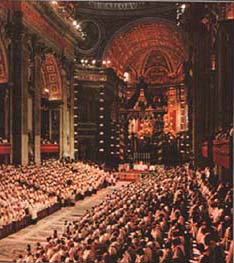 Short and sweet. Enjoy it; we don't get too many in the Vatican II department:
Professors who are appointed to teach liturgy in seminaries, religious houses of study, and theological faculties must be properly trained for their work in institutes which specialize in this subject.
In other words, a Roman collar is insufficient.
Short and sweet. Enjoy it; we don't get too many in the Vatican II department:
Professors who are appointed to teach liturgy in seminaries, religious houses of study, and theological faculties must be properly trained for their work in institutes which specialize in this subject.
In other words, a Roman collar is insufficient.


